The oven was worth less than the truck to haul it.
Victor Wolf knew that before he crouched beside it, and he crouched anyway, because his father had taught him that a man who priced from the doorway got robbed by the room. He opened the deck door and put his flashlight on the stone.
The stone was cracked, not all the way through, but enough to matter. A pizzeria on Bay Parkway had made forty years of pies on this stone and then made none. The owner had cried at the auction. Victor had paid her eleven hundred dollars for everything in the kitchen, and she had hugged him like he'd done her a favor.
He hadn't done her a favor. He'd done the arithmetic, then felt bad about it, which didn't change the arithmetic.
Above him, the six-minute train came in on the elevated tracks and shook the windows in their frames. It had done that every six minutes since 1917, give or take a strike. Wolf & Son had been under those tracks for thirty-one of those years. The glass had never once broken. His father used to say the building had stopped noticing.
Victor clicked the flashlight off and found the tag.
There was already one on the oven. His father had bought this same oven from the same pizzeria in 1998, sold it back to them in 2001, and written the tag in his slanted, impatient hand. The paper had gone the color of weak tea.
$400 firm. Don't let them cry.
Victor stood there long enough for the train to finish passing.
His phone buzzed on the oven's steel lip. It was a Jersey number: the buyer.
"Wolf," the man said. "I'm still coming at nine. Tell me about the oven."
"It's a deck oven. Two decks. Gas."
"I know what a deck oven is. Tell me about the stone."
Victor looked at the crack. His father would have said the stone was seasoned. His father would have said forty years of pies gave it character. He'd have said it with a straight face, and the buyer would have paid.
"The stone's cracked," Victor said. "Bottom deck. You'd want to replace it."
There was a pause on the line, long enough to be insulting.
"You know you're supposed to lie to me, right?"
"I'm saving the lies for the dental chair I'm selling you."
The buyer laughed, which was something. "Nine o'clock. Have coffee."
"I'll have coffee," Victor said. He hung up and looked at the crack again.
Honest was cheaper in the long run. That was his own line, not his father's. Some months he believed it.
He took a fresh tag from his shirt pocket, wrote $350 in his own square capitals, and tied it on under his father's. He didn't write anything about crying. He'd never had the knack for the second line.
The warehouse was full of other people's endings.
There were fryers and office chairs, a dental chair with the light still attached, and forty folding tables from a church that had merged with another church. Every one of them had a tag, and most of the tags were in his father's hand, because most of the stock had been sitting there longer than Victor had been running the place.
He'd been running it three years, long enough to know the work and not long enough to make it pay.
The office was a glass box at the front with a desk, a chair that leaned left, and a safe older than both. Victor had left the safe open for the day's cash bag. The bag was thin. It was always thin on Thursdays.
The letter from the bank sat on the desk under his coffee cup. He hadn't opened it, and he didn't have to. Two payments behind on a building loan meant a letter with the word "notice" in it, and he could read the word through the envelope.
He moved the cup to get the bag.
His hand knocked the black ledger instead.
It sat on the bottom shelf of the safe, where it had always sat: a fat book bound in black leather, swollen at the spine with age and damp. His father had kept it there for as long as Victor could remember. As a boy he'd asked what was in it. His father had said, "Old accounts," and shut the safe. As a teenager he'd tried to open it. His father had taken it out of his hands without a word, and that silence had been worse than any lecture.
His father had been dead three years. The book had stayed on its shelf the whole time. Victor had never opened it.
Tonight, with the bank letter on the desk and a cracked oven in the warehouse, he picked it up and set it on the desk. It was heavier than it looked. The leather felt warm, which was stupid. Leather in an October office was not warm.
He didn't open it. He sat and looked at it like a man looking at a bill he'd decided to pay tomorrow.
That was when something exploded outside.
The sound came first, a deep cough of fire, and then light, orange and wrong, flared across the front window.
Victor went to the door because everybody under the tracks went to the door. Nobody went outside. You looked, and you kept your hands in your pockets.
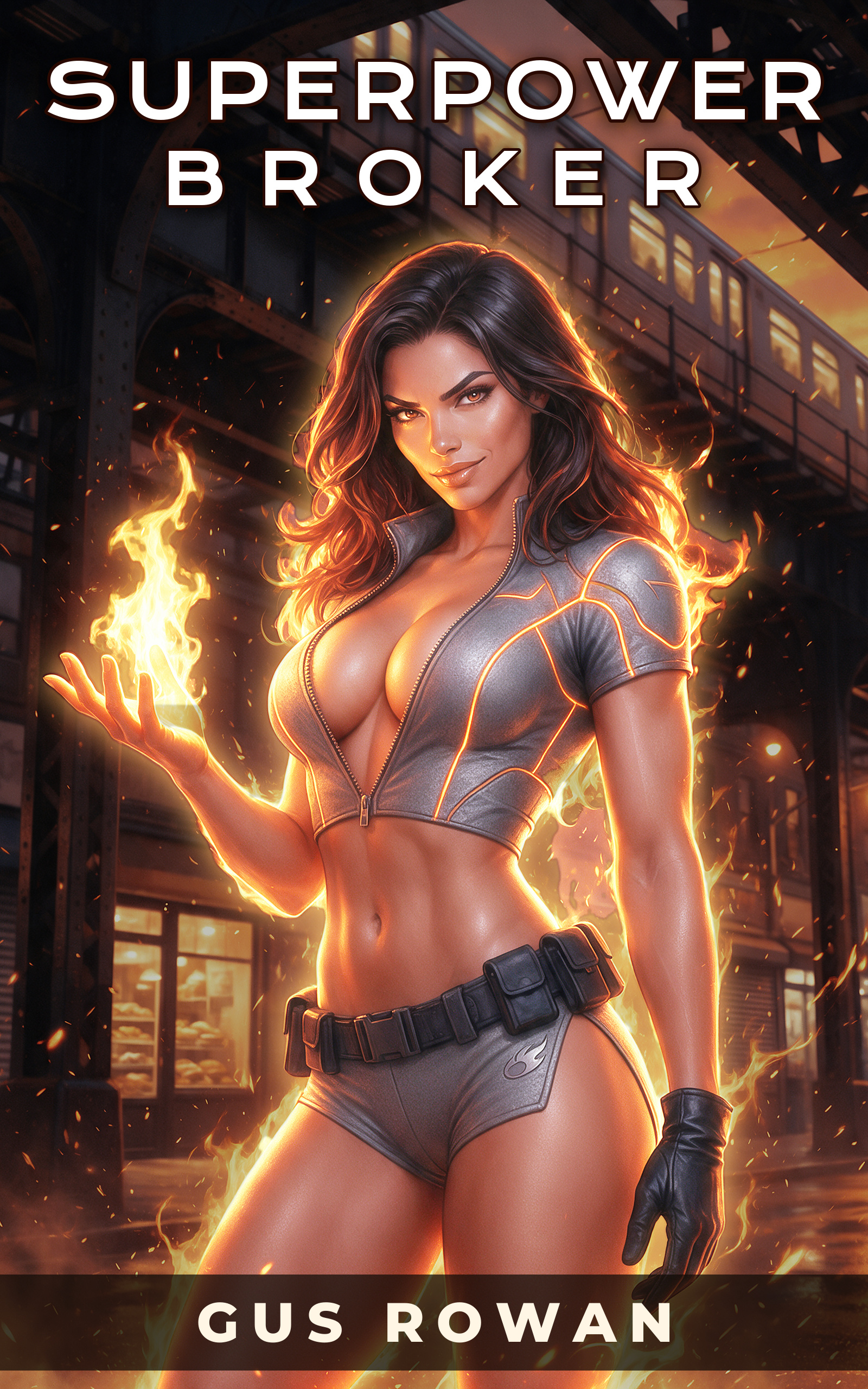
Under the elevated line, in the middle of 86th Street, a woman in a fire-gray suit was fighting a man in a hoodie.
The suit had a patch on the shoulder: a corporate logo, a silver U over a flame, and the license number stitched under it. She was a licensed hero, then, on the books. The kind who had a corporation behind her and a permit that made her power legal, instead of a felony.
The man in the hoodie had no patch. He had his hands locked on her forearm. Literally locked. Victor could see the fingers clamped like a vise, white at the knuckles, not moving even when she swung him off his feet.
A ghost. That was what the block called the ones without a license. People who'd come into a power and couldn't afford, or didn't want, the corporate paperwork that went with it. Under the tracks, ghosts were neighbors. You didn't call anybody about a ghost.
The woman's free hand went white with heat.
She put it on the man's wrist. He screamed. His grip broke. He fell back on the asphalt, rolled and ran east toward 18th Avenue with his hands smoking.
The train came in overhead. Its brakes drowned the screaming.
People were filming from the windows above the bakery. Victor could see the little squares of light.
The woman didn't chase the ghost. She stood in the street with her arms out from her sides, like someone who'd touched a stove and was waiting for the burn to arrive.
It arrived all at once.
Fire climbed out of her gloves. This was no flare. It was a steady crawl of flame up her sleeves, over the seams of the suit, which glowed orange at the stitches. She looked down at herself. Even from the doorway he could see her face change.
She was looking for someone to stop it.
There was no one. There was the train overhead, the lit windows above the bakery and Victor in his doorway with a flashlight in his pocket.
She took three steps toward his light. Then two more. The fire took the cuffs of her gloves and she stumbled. She came through his open door already falling, and the floor caught where she landed.
The extinguisher was from 2009. He knew because he'd priced it once, out of habit, and decided it wasn't worth the tag.
He pulled the pin anyway. White powder hit her and did nothing. The fire ate through it like the powder was a rumor.
"Don't," she said. Her voice was raw. "Don't touch me."
"I'm not touching you. I'm putting you out."
"You can't."
He was learning that. The floorboards around her had started to smoke. A moving blanket hung on the hook by the office, the padded kind they wrapped furniture in. He grabbed it and threw it over her legs.
It smoldered for a second, then caught.
He pulled it off before it could become another problem. His hands stung. He looked at her face. She was young, maybe twenty-five, with dark brows and a strong jaw, and under the soot she was beautiful in a way that made the moment worse. Her eyes were open and very clear and very scared.
"How long," he said. "How long does it do this?"
"It doesn't stop." She said it flatly, like a fact she'd had a long time to get used to. "Not anymore."
The fire was at her collar now. Her gloves had burned down to the wrist seams. Above the black remains of the left one, a strip of bare skin showed between glove and sleeve. It was a pale band, like a watch tan, as if the skin there hadn't seen light in years.
Victor didn't stop to think about it.
She had come down just inside the door of his father's office, beside the desk. His left hand was braced on the desk's edge, flat on the black ledger, where he'd caught himself when she fell. His right hand went out and closed around her bare wrist.
It should have cooked his palm. It started to. He felt the heat bite in, felt the skin go tight and wet.
Then the ledger opened under his other hand.
He felt it before he saw it: the cover lifting against his palm, the pages turning by themselves with a dry riffle like a deck of cards. The leather was hot now.
And her fire went out of her.
It didn't go out. It went away. It drained out of her arm the way water goes down a drain, in one long pull he could feel through his fingers. Up her wrist. Into his hand. Through him somehow, a rush like static in his teeth. Down his other arm into the book.
It took maybe fifteen seconds. He couldn't look away from her face, and her face did a whole life in that time. Fear. Confusion. Then something he had no word for, as the heat went out of her skin and she felt his hand on her wrist.
A hand was on her skin, holding on.
The flames on her suit guttered and died. The floor smoked and stopped.
She was cold. He could feel it through his blistered palm. Cold and shaking and alive.
Behind his eyes, a page opened.
He didn't see it with his eyes. He saw it the way you see a phone number you've memorized, complete, without looking. There were ruled lines and columns, and writing filled them as he watched, in a hand he knew better than his own.
The hand was slanted and impatient, and it was his father's.
```status LIFT | Fire (B) | Zoe Castellan Rescue | Hold 30 days CUT +50 ```
He read it twice, and it didn't get any less insane.
Lift. That was what it said his hand had done: lifted her fire out of her, like a man lifting a crate. Fire was the power. The B beside it looked like a grade, the way you'd grade a used oven. Rescue was how he'd come by it: he'd pulled it off her to save her life. Hold thirty days. The word sat there like a line on a pawn ticket, a thing kept for a term and owed back. Except it wasn't a pawn ticket. Pawn tickets didn't write themselves in a dead man's handwriting. At the bottom, CUT +50, like a broker's fee. Somebody was taking a commission. He had no idea who.
He knew her name now, because the page had written it. Zoe Castellan.
"Where is it?" She was staring at her own hands. At his hand. "Where did it go?"
He looked at the ledger. It lay open on the desk, flat, its pages still settling. Her fire had licked the open cover on the way in. The leather didn't have a mark on it. Not a scorch. Not a curl.
"I think," Victor said, "it's in a book."
She laughed. It was a terrible laugh, half a sob. "That's not funny."
"No," he agreed. "I'm not trying to be."
He let go of her wrist. She grabbed his hand back immediately with both hands and held on hard. He didn't think she knew she was doing it.
"Okay," he said. "Okay. You're okay."
"I'm cold." She sounded amazed. "I'm cold. I haven't been cold since..." She stopped. Her teeth had started to chatter. "Who are you?"
"Victor. This is my shop."
"Your shop is on fire."
"A little. It's mostly out."
She looked past him at the smoking floorboards and the blackened blanket in the doorway, then back at his face. Her grip didn't loosen.
"You touched me," she said.
"You were burning to death on my floor."
"Nobody touches me." Her voice cracked on it. "Nobody can. That's the whole..." She pressed her lips together hard. When she spoke again it was quieter. "Your hand. Let me see your hand."
He turned it over. The palm was red and blistered, the skin shiny where her heat had bitten in. She stared at it like it was the worst thing she'd ever done.
"That's not bad," he said. "I've done worse moving a fryer."
"Don't lie to me."
"Fine. It hurts like hell. It's still not bad. Can you stand?"
She could, barely. He got her onto the couch in the office. She weighed what a person weighed. That seemed to surprise her, as if she'd expected to be lighter with the fire gone. She was shivering so hard her teeth clicked. He found a second moving blanket that wasn't on fire and put it over her. She pulled it up to her chin.
"I need to call somebody," she said. "My team. My handler. Somebody."
"Your phone melted."
She looked at the black lump on the floor that had been in her thigh pocket. "Per brand guidelines," she said faintly, "that's a replaceable asset."
"Is that a joke?"
"It's a quote. I'll let you know if it turns into a joke."
"Do you want me to call an ambulance?"
"No." Fast and certain. "No hospital. If they test me tonight, I'm done."
"Done how?"
She didn't answer that. She looked at the ceiling instead, at the water stain shaped like Ohio, and her eyes filled.
"Four years," she said, to the stain. "Four years since anybody touched me."
He didn't know what to say to that, so he didn't say anything. He went to the sink in the back and ran cold water over his palm. It hurt the way burns hurt, deep and stupid and personal. When he came back she was asleep, or something like it, her face gray under the soot, one hand still out from under the blanket as if she'd been reaching for something.
The ledger was still open on the desk.
He shouldn't have looked. He'd been told not to his whole life. But his father was dead, and the book had just eaten a woman's fire, and the rules of his childhood seemed thin next to that.
He looked.
The page he'd seen behind his eyes was there in ink. His father's slanted hand. The name, the grade, the hold. Below it, a dozen lines down, the ruled paper was blank and waiting.
Before it, older pages. Columns of entries going back years. Initials, letters, numbers. Old accounts, his father had said. Victor turned one page and his stomach went cold. They weren't accounts for fryers and folding tables. He didn't know what they were, or enough to read them yet.
He turned back to Zoe Castellan's line.
Something else was written beside it.
It wasn't in the columns. It was in the margin, small and old-fashioned, the letters joined in a way nobody had been taught in fifty years, in ink that had gone the faded brown of an old photograph.
It wasn't his father's hand, or anybody's hand that he knew.
One word, beside her name, as if somebody had been reading over his shoulder and couldn't help commenting.
Mine.